This is my favorite dessert hands down. I first found out about this dessert when I went to study abroad in China for the first time in Hainan province. This was a local favorite for the university students near Hainan University. The street next to the southern gate of the campus was always vibrant and full of delicious and interesting things to eat. As far as dessert goes though, this one was special. It is called Chaobing and literally means 'fried ice'. Of course it does not mean fry in the hot sense but actually in the cold sense. It is perfect way to cool down on a hot summer night in China. You won't find this being served in the day time though. I thought they could make lots more money that way, but it was no exception. China has a 'night market' culture where all the treats come out at around 7 pm and go on until late at night.
You eat this special dessert by choosing fruits of your choice. The fruits that were chosen for the Chaobing in the picture above were grape, papaya, and apple. Yummy combination. Usually the vendors will allow you to choose three fruits. After that they will blend the fruits into juice and add some condensed milk. Then they will proceed to add the juice+milk onto an evaporator. This machine makes the blended juice+milk very cold. They will keep flipping the juice+milk until it begins to harden and become an ice cream like consistency. Add raisins and crushed peanuts to the top and there you have it. The best dessert on the planet.
Take a look at this video to see what it looks like when they flip the Chaobing.
I hope one day you will be able to try Chaobing. Unfortunately I have never seen this dessert being sold anywhere except for Hainan province. My friends from the north actually didn't know what Chǎobīng was and would always think I am pronouncing it wrong and actually referring to Chǎobǐng 炒饼. A dish pronounced the same way with different tones. This light and refreshing dessert should be on the to-eat list of anyone visiting Hainan.
I made a short video on some of the foods I have come across in Sichuan province. Sichuanese food otherwise known as Szechuan food is known for being very flavorful and spicy. Actually the famous Kung Pao Chicken is a Szechuan food which is featured in the short video I made. The foods in the video were eaten when we were in Chengdu, the provincial capital of Sichuan province. In China there are basically two types of fast food, western and Chinese. If it is Chinese fast food there is a 90% chance that it will be related to Szechuan food. Take a look at the video and let me know what you think.
In the video we ate deep fried string beans (干煸四季豆), Kung Pao chicken (宫保鸡丁), twice cooked pork slices (回锅肉), and Szechuan hotpot (四川火锅) . My favorite was the hotpot. It had a spicy-sour taste that was so good after a long day without eating. The deep fried string beans were alright. Kung Pao chicken is what the Chinese always think foreigners will love and sure enough, as foreigners,we did. As for the twice cooked pork slices, you can't go wrong ordering that.
The name Xian (西安) in Chinese means western peace. It is one of China's most important cities especially for history and culture and my experience there was nothing less than wonderful. My time in Xian was spent with my three Korean friends that I brought from Beijing with me. Minchul (민철), Sunghyun (성현), and my other friend Yeonchang (연창), set off to Xian to accomplish three things. Climb Mt. Hua, see the terracotta warriors, and see one of the biggest fountainshows in China. Well we accomplished what we set out to do, and it was a blast. This wasn't without the pain though. In a rather ill planned move, we decided to take all of our gear (computer, clothes, snacks, and some water) with us up Mt. Hua. This was over 2000 m of pure stairs... our legs were hurting for weeks after.
One of the peaks of Mt. Hua
Most of the Chinese climbing Mt. Hua do it with minimal gear. The drawback to this is that you need to buy the overpriced bottled water that the locals haul up the mountain everyday on their back. I guess this is ok seeing that it is how they make their living. Do not be fooled though, it is a general rule of thumb that the higher you go, the more expensive the water. Sometimes the locals will try to charge your more at the lower levels though, so just bargain a little saying that if you don't make it a little cheaper, you'll just go to the next pit stop and buy. Also, keep in mind that at the top, you will most likely want to eat something. There are small places you can buy water, pastries, and instant noodles on the way and on the top, but the instant noodles are a million times more expensive than what they are worth on the ground. So plan accordingly if you are traveling on a budget like we were.
On the way down Mt. Hua
Terracotta Warriors
The terracotta warriors (兵马俑) were to be honest, less spectacular than I thought. Ok history buffs, don't get too mad. It's just that before I got to the site, I could have sworn that I've seen pictures that were much more spectacular than what I saw. What is interesting though, is to see that there are still Indiana Jones' doing their research on the warriors and digging them up. BUT, even if it wasn't that spectacular, I would still say that it is a must for people coming to visit China. I mean, isn't that what most people would ask you when you get back from a trip to China? "Did you see the terracotta warriors?" If you say no... then boo on you.
View of dug up terracotta warriors
I believe this was a swordsman without the sword in his hands
Notice the difference between this archer and the swordsman above. There were generals, and horsement among other warriors too, each with their specific jobs, and different appearances to reflect that.
Yangrou Paomo (羊肉泡馍)
After seeing the terracotta warriors boy were we hungry. We decided to eat the unique food to Xian... Yangrou Paomo or literally, "Lamb Meat Foam Pieces," tastes better than it sounds. If you go and eat some, don't be fooled by the pieces of bread that are placed on the table before you. You are supposed to pulverize those pieces of bread with your bare hands until you make very small chunks with them. Stick the chunks in your bowl, and when everyone is ready, call the waitress over. She will take those chunks to the kitchen where the chef will pour the special soup and lamb chunks over the pulverized bread you just made. Add your own cilantro after if you like, or any additional condiments. What you end up with is a Xian-licious meal.
Seonghyeon (right), Minchul (middle), and Vincent (left) making their bread chunks
Xian Musical Fountainshow (音乐喷水)
Not only do you get to see a musical fountainshow in Xian, but you also get to play in it. This was totally unexpected, but we saw other Chinese making their way into the fountainshow when the show started to get intense. This was definitely one of the most fun and memorable events in all of my travels. It starts around 8pm nightly and is definitely a good way to enjoy yourself if you are on a budget... it is FREE!
Xian Musical Fountainshow
The Xian Experience
I was in Xian for only two days but experienced so much. This was the beginning of a long journey that began in Beijing and went through China and Southeast Asia and eventually to Japan. Xian is an ancient city but it is still vibrant and hip. Young people are out and about during the night and enjoying stuff like the fountainshow. I would recommend Xian to anyone wanting to travel to China. Ancient history and modern culture rolled into one... I know it sounds like most Chinese cities, but trust me, Xian is special.
Lonely Planet: China
Below is the Lonely Planet Guidebook for China. I would highly recommend this as I often used this as a reference for a wide range of things from finding places to sleep to transportation to eating, and more. The important thing about traveling in China and most of Asia in general if you are on a budget is to get to know the prices of things. Guidebooks like Lonely Planet do a pretty good job at telling you approximately what price things should be so that you don't get ripped off. Click on the image and it will take you to amazon.com where you can purchase your own copy of the book.
Recently there was a state tournament for Hawai'i high school baseball held on the island of Maui 5/5/10 - 5/9/10. I was lucky enough to be able to leave my O'ahu island home to watch the tournament with my mom, dad, and two brothers (the youngest one competing in the tourney). Before leaving I was ecstatic. Not only was I going to be able to watch the baseball game and root for my hometown (Kailua), but I was also going to be able to see Maui. Maui, otherwise known as the Valley Isle, is the second largest island in the Hawaiian Archipelago, and definitely one of the most beautiful.
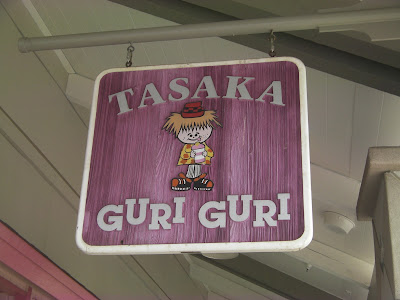
Oh but let's not forget Maui's favorite manju and Guri Guri ice cream! In addition there are some really 'ono* places to eat. Da Kitchen Express in Kihei was absolutely delicious, where I've tried the Loco Moco, Fish Tempura, and Banana Cream Pie. The servings were so big! Luckily I had my mom, dad, and brother to share the food with.
Famous Guri Guri Ice Cream Store
Guri Guri Icecream with the two flavors Pineapple on top and Strawberry on the bottom
Da Kitchen Express Kihei
Fish Tempura (Left) Banana Cream Pie (Middle) Loco Moco (Right) from Da Kitchen
Places Visited
Most of the trip was spent in either Wailuku, where the baseball tournament was held, or in Kihei where our hotel, the Maui Banyan was located. In addition to that though I made two trips, one from Kihei to Honolua Bay, and another from Wailuku to Haiku, that were the most memorable.
The baseball tournament was held in Maehara Stadium located in Wailuku next to the War Memorial Stadium. Maehara Stadium was built in 1973 and showed some signs of its age. Winds were always strong there, blowing in directly from the coast, which always made it cold to sit in the shade.
Maehara Stadium
My brother Kory makes a run for third base
Most of the time spent after the games was at the hotel having a barbecue outside and having a good time. One of the nights we decided to buy local, so we went to Takamiya Market in Kihei to get our meat. The meat was so 'ono* and it felt really good to support the local economy. People from Maui always seem open to strike up a conversation with, and the Mauians in Takamiya Market were definitely of the hospitable kind.
Kihei to Honolua
The road from Kihei to Honolua offers some spectacular views. Since there was a game that day at 1:30 p.m. the goal was to make it all the way to Honolua Bay and back by 1:00 p.m. We started at 8:30 a.m. and we were able to do it in time. On the way we passed Kalama Park, with the beach full of stand-up paddle boarders. Near the park entrance there is a huge model of a humpback whale. Humpback whales come to the area every year. Next we passed Kealia Pond then Māʻalaea* which offered some spectacular views. From Māʻalaea to Oluwalu you have to drive through windy roads with dry scenery. What is nice around here is that you get to see Molokai island up close. Next we drove through Lahaina* and finally down to Honolua Bay. Lahaina used to be the capital of the Hawaii from 1820 till 1845 and was a whaling town. As a result there are many historical sites in Lahaina making it a really interesting town. Honolua* Bay apparently consists of two parts. One for snorkeling and the other for surfers. We only stayed at the snorkeling part, as we didn't have much time to explore.
This trip was taken with my mother and her friend, Maui resident Laurie. From Wailuku we made our way to Pāʻia* passed Ho'okipa Beach Park and finally paid a visit to Haiku. This trip was also very scenic as we got to see better views of Haleakalā. Pāʻia is a very hippie town with many small shops selling things ranging from antiques to all-hemp products. It is a sight to see, and a must if you are seeking for a cultural tour of Maui. Next we stopped by at Ho'okipa* Beach Park. Ho'okipa is the windsurfing capital of the world, and yes, there were a lot of windsurfers when we got there. Finally Laurie took us to her town of Haiku, a little ways up the road headed to the higher parts of Haleakalā*.
The sign at Ho'okipa Park has experienced its share of poetic license
Apparently you can drink alcohol in county parks in Maui
The final day me, my brother, and dad took a quick trip up to ʻĪao* Valley where the famous ʻĪao Needle is located. ʻĪao Valley was the site of the battle of Kepaniwai* between Kamehameha the Great and Kalanikūpule. The valley is actually rainforest and one can still see the locals going for a swim in ʻĪao Stream below. The needle itself served as a lookout point for invaders in ancient Hawaiian times, but hiking the needle looks near impossible. Kalo (Taro) is still grown here and it offers a glimpse into the lifestyles of the Hawaiians of old.
ʻĪao Needle
Too Short of a Trip
On this trip to Maui I didn't even get to see the sunrise on Haleakalā or experience the road to Hana and all of its beauty within my 5 days there. Those things will definitely get priority on my list of things to do next time I get to Maui. Everytime I leave Maui I am a little sad. The people and the beauty of the island makes you want to stay... and oh yes, the food! I hope I have the opportunity to go again soon. As my mom told me several times on the trip, "Here today, gone to Maui!"